


U.S. States Can Make Significant Impact on U.S. Emissions Despite Federal Headwinds
New EDF analysis, which uses 2025 projections from Rhodium Group, assesses the collective impact that U.S. states with climate commitments could have on national emissions.
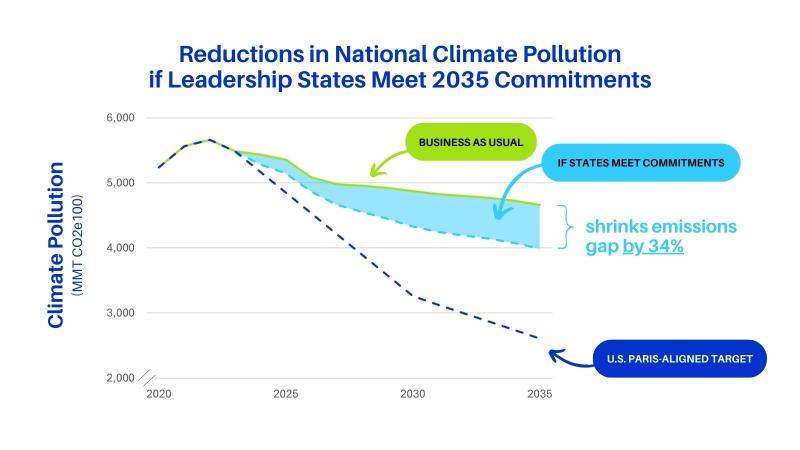
NEW YORK — New analysis from Environmental Defense Fund, released during New York Climate Week, shows that, if climate leadership states achieved their goals, they could close the emissions gap to the U.S. Paris Agreement target by a third. The analysis also showcases proven pollution-cutting policies that states can use to reach their goals.
“While D.C. drives up electricity prices by propping up costly, dirty coal plants and blocking clean energy, leadership states must hold the line on commonsense solutions,” said Pam Kiely, Associate Vice President for U.S. Region at Environmental Defense Fund. “These states have the power and the opportunity to put forward their own policies that cut costs, protect families’ health and curb climate pollution. Our analysis shows that leading states must rapidly pick up the pace on implementing policies that limit climate pollution — and leading economists are showing that those same policies can be powerful affordability tools as well.”
The political headwinds are strong, with the federal government blocking clean energy at every turn — taking affordable options off the table at a time when Americans are facing rising electricity bills.
Fortunately, states are already stepping up to demonstrate how climate ambition and affordability go hand-in-hand.
- California recently passed sweeping climate legislation that included extending their pollution-cutting cap-and-invest program and opening up the door to building an interconnected regional electricity market across the West. The state’s cap-and-invest program is projected to create 287,000 jobs and $55 billion in economic growth over the next two decades.
- Last November, Washington state successfully defended its cap-and-invest program from a dangerous ballot measure, winning by a 2:1 margin as voters spoke up strongly to preserve cost-saving and pollution-cutting investments. The state is now pursuing linking its program with California’s.
Now it is time for more states to step up to the plate by placing firm, binding limits on their emissions to cut pollution and cut costs for their communities.
With more than 3 million members, Environmental Defense Fund creates transformational solutions to the most serious environmental problems. To do so, EDF links science, economics, law, and innovative private-sector partnerships to turn solutions into action. edf.org
Related Expert

Associate Vice President, U.S. Region
Latest press releases
-
At public hearing, EDF strongly opposes abandonment of protections against power plant pollution
October 2, 2026 -
Coalition Sues Trump Administration Over Rule Making Cars Less Fuel Efficient
October 2, 2026 -
Virginia Governor Spanberger releases energy plan to meet clean energy goals
October 1, 2026 -
Environmental Defense Fund appoints new Japan Region Chief
September 28, 2026 -
In the midst of soaring gas prices, Trump administration weakens fuel economy standards for new cars and trucks
September 28, 2026 -
Report: U.S. clean power continues to grow as cancellations, gas development accelerate
September 28, 2026