


Coming soon: The race to create a West-wide power market begins
This Friday, the race to create a West-wide power market will officially kick off — with major impacts on electricity costs, grid reliability and clean energy development across the vast Western region of the continental U.S.
What’s happening?
The Extended Day-Ahead Market (EDAM) will begin operating May 1, governed under a soon-to-be formed independent Regional Organization for Western Energy.
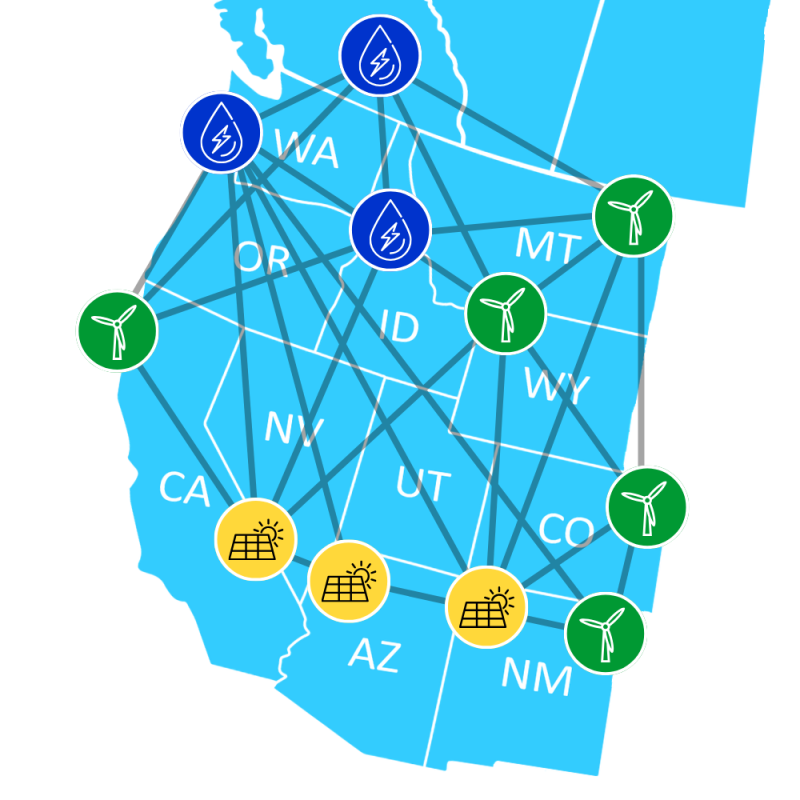
EDAM will allow utilities to plan and optimize the sharing of electricity across the region — with the goal of tapping into solar power in Arizona all the way to hydropower in Washington — at a time when rising demand and extreme weather are putting tremendous pressure on the grid. Unlocking that broader access will support more clean energy across the West and offset the need to run and build local, costlier fossil fueled power plants.
The launch follows the debut of a competing day-ahead market — called Markets+ — run by the Southwest Power Pool, which is also signing up Western utilities.
The central question for Western utilities, households and businesses now: which power market will deliver the greatest savings and reliability benefits?
Why does a day-ahead market matter?
Peak electricity demand is expected to grow 30% across the West in the next decade from new data centers, industry, and electrification of buildings and transportation — tripling the demand growth from the last decade. Additionally, the grid is increasingly under stress from extreme weather events — like the record-breaking heat wave in March.
Exacerbating these challenges, electric power coordination in the region is like the Wild West. It’s one of the few regions in the U.S. without a coordinated system to buy and sell power from utilities across the region a day in advance. Instead, 38 utilities rely on a patchwork of bilateral agreements — a fragmented approach that makes it hard to move power efficiently from where it’s generated to where it’s needed.
While the region does have a real-time market to trade electricity, the advanced planning offered by a “day-ahead” market is critical: it allows utilities to shop from a broader pool of resources across states, often at lower cost, instead of being limited to only local resources. It’s a bit like shopping at a convenience store like 7-11 versus a large store like Costco — access to more options typically means more savings.
- Savings: Much of the potential cost reductions for bills comes from greater access to the cheapest power across the region, like wind and solar, which can bid into the market at very low cost — even $0, because there are no fuel costs. But currently, some of that clean power is being wasted. The Brattle Group estimated that a day-ahead West-wide market could capture and deliver 270 MW in unused clean energy alone — enough to power nearly 300,000 homes each year.
- Reliability: During extreme weather like heat waves, a widespread day-ahead market can be bigger than the weather, helping route power to areas at risk of outages or price spikes before shortages occur. Research from Stanford found that the West would have less risk of outages with one large market, rather than multiple markets.
How much savings are we talking about?
Studies reinforce a key finding for utilities and ratepayers: the bigger the market, the bigger the savings. That is, when the grid works as one large market instead of multiple smaller ones, utilities can buy lower-cost power more often — and those savings flow to households and businesses.
- Arizona: If all of Arizona’s three major utilities join EDAM, the state could see $114 million in annual savings compared to Markets+, which could offset recent and pending rate hikes.
- Colorado: Xcel Energy Colorado would reduce costs on average $13.2 million annually by participating in EDAM as compared to Markets+.
- California: A single, unified EDAM market across the West would result in approximately $350 million in average annual cost-savings for California, compared to a split market scenario.
What to watch for next
Some utilities have already decided which market they will join or made their preference for either EDAM or Markets+ known.
As more utilities evaluate their options, they should choose the market that will deliver the greatest cost-savings and reliability benefits.
If you have questions and/or would like to speak with one of EDF’s experts on electricity markets, Michael Colvin, Director, California Energy Program or Alex DeGolia, Director, State Legislative & Regulatory Affairs, please reach out to me at chgreen@edf.org.
Related Expert

Director, Regulatory and Legislative Affairs

Senior Director, Clean Electricity
Latest backgrounders
-
Coming soon: Trump administration poised to weaken national methane protections
September 23, 2026 -
EDF, IUCN and IWMI call for accelerating action on the global groundwater crisis ahead of the UN Water Conference
September 23, 2026 -
Congress votes on misguided measures attacking California’s long-guaranteed right to protect people from air pollution
September 17, 2026 -
Coming soon: Trump administration attacks on protections against climate pollution from power plants
August 27, 2026 -
Trump administration cancels major electric transmission corridors intended to curb costs, strengthen grid
August 13, 2026 -
The FDA recently made its first move on a 1958 food-chemical law. Why now?
July 29, 2026