


Proposed legislation would lock North Carolina into expensive, outdated energy sources in a time of high bills and growing electricity demand
RALEIGH, N.C. — Legislation introduced in North Carolina House Energy and Commerce Committee today would mandate the state's continuing reliance on aging and increasingly expensive coal-fired power plants. The proposed committee substitute for Senate Bill 730 mandates that Duke Energy must continue operating its remaining fleet of coal-fired power plants — which are among the costliest sources of energy in its generation mix — and arbitrarily constrains the economic selection of affordable and available new sources of power.
“At a time when North Carolina households are continuing to struggle with record-high electricity bills, this proposal puts much needed relief further out of reach by forcing families and businesses to rely on outdated, expensive, polluting coal plants,” said Will Scott, North Carolina Policy Director for Environmental Defense Fund. “Limiting North Carolina’s access to the lowest cost and fastest-to-build sources of power — solar, wind and battery storage – guarantees higher bills and more health-harming pollution for communities. North Carolina made a commitment to pursue affordable and reliable power — this proposal takes us in the wrong direction.”
New analysis, commission by Environmental Defense Fund and conducted by energy analytics firm EQ Research, examined Duke Energy’s own public filings with the NC Utilities Commission which show that, on average, competitively procured clean energy has been over 40% cheaper than power from natural gas and 30% cheaper than power from coal over the last four years. Additional analysis shows that costs associated with Duke’s natural gas investments are responsible for up to 67% of recent customer bill hikes.
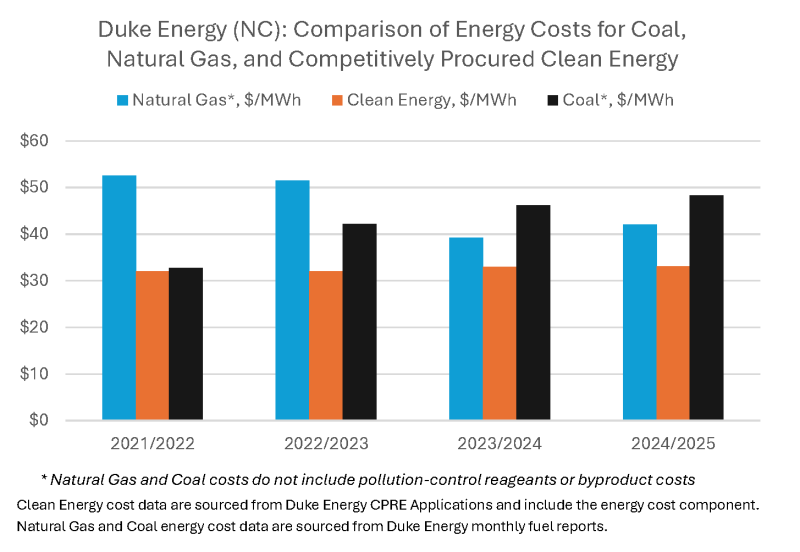
Last year, despite clear, compelling third-party analysis demonstrating significant additional cost would be shifted on to North Carolina households, legislators adopted S266, the so called “Power Bill Reduction Act.” And in the intervening nine months, many North Carolinians have indeed seen record power bills along with Duke Energy requesting an 18% rate increase for residential customers.
Other sections of the bill acknowledge growing concerns statewide about the cost, community and environmental impacts of surging data center investment and project development. Senate Bill 730 layers on additional local review of proposed data center projects and proposes some small steps in the right direction of protecting customers from the significant cost of energy system upgrades necessary to serve new data center demand. But the bill stops short of allowing data center developers to self-finance clean energy to satisfy some or all of their energy demand and would keep those investments off household electric bills.
“If affordability is truly the goal, this bill should allow data centers to pay for their own new, clean energy as other states are doing. Mandating continued coal power to meet growing data center demand is the worst of both worlds — higher costs and more pollution,” said Scott.
With more than 3 million members, Environmental Defense Fund creates transformational solutions to the most serious environmental problems. To do so, EDF links science, economics, law, and innovative private-sector partnerships to turn solutions into action. edf.org
Related Expert

North Carolina Policy Director
Latest press releases
-
Pairing conservation and competitiveness leads to stronger American fisheries
October 26, 2026 -
Behind closed doors, Trump EPA worked with White House to help polluters avoid enforcement
October 26, 2026 -
Groups File Lawsuit Challenging Delay of Greenhouse Gas Reporting Program
October 23, 2026 -
Coming Soon: A Trump EPA proposal to weaken pollution limits for the turbines that power data centers
October 20, 2026 -
Delaying major IPCC report risks leaving global decision-makers in the dark
October 19, 2026 -
Oral argument in a lawsuit challenging unlawful delays of methane pollution limits
October 13, 2026