


Mercury in tuna: Is canned tuna safe?
The tuna sandwich is a lunchbox staple. But several species of tuna — like other large ocean fish — contain higher-than-average amounts of mercury, a highly toxic metal that can cause severe health effects.
This is of particular concern for young children, since their nervous system, brain, heart, kidneys and lungs are all susceptible to the harmful effects of mercury.
Where does mercury come from?
Mercury comes from both natural sources — like volcanoes — as well as man-made sources like air pollution from power plants and other industrial sources that burn fossil fuels. Once it enters the atmosphere, mercury rains down on rivers, lakes and oceans, where it then enters the food web.
How much canned tuna is OK?
Fortunately, parents and kids need not give up tuna altogether. By paying attention, parents can safely include tuna sandwiches in their kids' lunch boxes, in moderation.
There are two main kinds of canned tuna: chunk light and solid or chunk white (albacore). Mercury levels in canned white tuna, which is exclusively albacore, are almost three times higher than those found in smaller skipjack tuna commonly used in canned light tuna products.
These recommendations are based on EPA guidance and estimates of mercury in the most popular canned tunas:
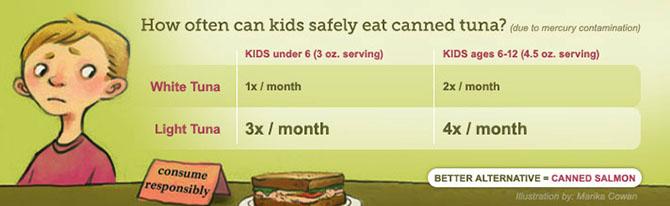
- Canned white, or albacore (0.32 parts per million of mercury). Children under six can eat up to one 3-ounce portion a month; children from 6-12, two 4.5-ounce portions a month. Adults, including pregnant women, can safely eat this kind of tuna up to three times a month (women, 6-ounce portions; men, 8-ounce portions).
- Canned light, the safer choice (0.12 parts per million of mercury). Children under six can eat up to three 3-ounce portions per month. Older children and adults can safely eat it once a week. But look out for "gourmet" or "tonno" labels. They are made with bigger yellowfin tuna and can contain mercury levels comparable to canned white.
- A better alternative is canned salmon (mostly sockeye or pink from Alaska), which is low in contaminants and high in heart-healthy omega-3s. It's also sustainably caught in Alaska and similarly priced, making it a great choice all around.
Keep an eye on lunch served at school
A study by the Mercury Policy Project found a wide range of mercury levels in both light and white tuna from government-sponsored school lunch programs. Some of the canned albacore/white tuna tested had almost four times the average level of mercury reported by the Food and Drug Administration.
Maximize your impact to reduce pollution and safeguard our health
Give now to defend our planet:
Your gift can help reduce dangerous pollution
Give now to defend our planet: