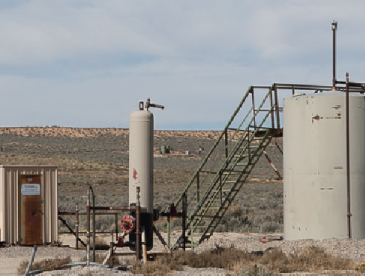
The economy may be struggling, but one American industry is in full swing: natural gas.
Across the country, natural gas (methane) production is booming as companies tap vast underground shale formations through a process called hydraulic fracturing, or "fracking."
Hydraulic fracturing involves pumping water, sand and chemicals underground, where they shatter shale rocks and release the gas. Shale formations cover huge areas of the country, from New York to Wyoming.
As an energy source, natural gas has a major advantage over coal and oil: when combusted, methane emits less heat-trapping carbon dioxide than other fossil
fuels and fewer dangerous pollutants like mercury. Methane can therefore ease our transition to a low-carbon economy – a must if our fight against catastrophic
global warming is to succeed.
Natural gas comes with one big drawback, however. EPA estimates that more than 2% of all the natural gas we extract is lost to uncontrolled venting and leaks from drilling operations, pipelines and storage tanks. And two percent is just an estimate – some studies suggest the real figure may be higher.
More potent than CO2
That’s a significant problem, because for all of methane’s advantages over coal when it is burned as fuel, the uncombusted methane that leaks from wells and pipelines is a greenhouse gas pollutant far more potent than carbon dioxide.
In other words, a leaky gas distribution system could undermine methane’s carbon advantage over coal and spell major trouble for the climate.
EDF scientists co-authored a paper in April 2012 examining the climate impact of natural gas compared to other fossil fuels. The scientists, who collaborated with three researchers outside EDF, found that new natural gas-fired power plants are better for the Earth’s climate than the most efficient coal plants as long as methane leakage from the well to the power plant is limited to 3.2% or below.
The scientists also found that, based on EPA's present methane leakage estimates, cars that run on compressed natural gas actually harm the climate for decades – to produce benefits immediately, leakage rates would need to drop below 1.6% from “well-to-wheels” (from the gas wells, through pipelines, to the cars themselves).
Based on the paper, EDF economists have created a modeling tool that allows users, including planners, engineers and business leaders, to understand how switching from coal or oil to natural gas can affect the climate, based on sector (passenger cars, trucks, electric power, etc.), leakage rates, and how efficiently the gas is burned. The model produces a graph and summary table accounting for any single scenario’s impact on the climate over time.
The good news is that leaks can be detected, measured – and reduced. EDF is currently collaborating with industry and academic partners on a series of five
scientific studies to measure methane leakage rates across the natural gas supply chain. Among our partners are the University of Texas, Duke University, Harvard University, Boston University and eight major natural gas companies. EDF aims to complete the entire study by December 2013.
Key environmental risks of natural gas development
Of course, methane’s contribution to global warming is not the only environmental concern heightened by the shale gas revolution. Today there are 45,000 shale gas wells operating in the U.S. – triple the number in 2005 – and states are grappling with widespread worries over potential damage to the environment.
Among the many other concerns are:
- Groundwater contamination. Wells need to be properly constructed to prevent the chemicals used in hydraulic fracturing from escaping into groundwater.
- Air pollution. Construction and drilling equipment from drilling operations can degrade local air quality with smog-forming pollutants and air toxics.
- Unsafe disposal of drilling wastewater, including the chemicals used in hydraulic fracturing.
- Degradation of rural landscapes. Traffic and noise can overwhelm communities and intrude on sensitive ecosystems and habitat.
So far, however, the natural gas industry – with notable exceptions – has largely opposed better regulation, or even basic disclosure of the many chemicals used in hydraulic fracturing.
To say the natural gas industry has a credibility problem is an understatement. Industry has been doing little to engage the public in a serious way.
Mark BrownsteinChief counsel, Energy program
EDF pushes for responsible development
EDF is working around the country to make sure that shale gas is developed correctly, in a manner that minimizes leaks of methane and protects the environment.
Says EDF President Fred Krupp, "It is crucial for industry, regulators and the environmental community to work together to make sure every molecule of natural gas is produced as safely and responsibly as possible. Unfortunately, the industry's response too often has been to argue that hydraulic fracturing can't possibly cause any problems. That kind of denial erodes public trust. That's why EDF is grateful to the industry leaders who are working with us to solve these problems."
In every state where shale gas is produced, we’re pushing for:
-
Mandatory disclosure of the chemicals used in hydraulic fracturing. The public has every right to know what chemicals industry is using in our backyards.
- Modernized rules for well construction and operation. To prevent the leaking of methane and pollution of groundwater with toxic chemicals, drillers must adhere to the strictest standards of well design, construction and operation.
- Tough state and national standards for improving air quality.
- Stronger state regulations for properly handling waste.
- Advanced planning that will reduce the impacts of drilling, like noise and traffic, on communities.
EDF president appointed to advisory committee
In early 2010, President Obama directed Energy Secretary Steven Chu to appoint a group of energy and environmental experts to recommend ways to improve the shale gas industry’s environmental performance and reduce the risks of gas production. EDF President Fred Krupp served on the panel, whose November 2011 report proposed a series of steps to increase industry oversight and transparency.
"As a starting point, we must all agree that everyone—no matter where they live—has a right to clean air and clean water," Krupp wrote in the
Wall Street Journal. "The advisory committee's report is tough and balanced – and implementing its recommendations will require government,
industry and environmentalists to work together to safeguard air and water quality." (Read the full op-ed [PDF])
In Colorado, a major victory
In Colorado, EDF helped win an important victory in December 2011 when the state Colorado Oil and Gas Conservation Commission adopted a groundbreaking new rule requiring drillers to disclose the chemicals used in hydraulic fracturing fluids on a well-by-well basis. EDF worked closely with Governor John Hickenlooper’s administration, local environmental groups and some forward-thinking gas companies to get the new rule adopted.
EDF has helped put similar rules in place in Wyoming, Texas, Arkansas and Montana. We’re also working with progressive gas companies to develop a set of model regulations that every shale gas state can use to ensure that well construction and operation does not damage groundwater or public health.
Even with tough rules in place, reducing methane emissions and minimizing environmental risk ultimately depends on industry embracing environmental responsibility. EDF is working to make sure that states and progressive forces in the industry forge a safer and healthier path forward.