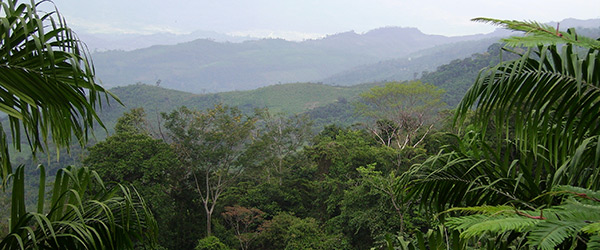
Brazil: Conserving forests to stop climate change

Finding innovative ways to protect local partners' most precious resource

Rainforest logging

Tropical deforestation causes about 15% of man-made carbon emissions, making conservation key to fighting global warming.

In 2005, the governor of a major Brazilian state received the “golden chainsaw award” for his aggressive promotion of tropical forest clearing. Much has changed since then.

In 2009, all nine state governors from Brazil’s Amazon region sent a signed declaration to President Luiz Inacio Lula da Silva calling for zero deforestation and access to carbon markets to fund forest conservation.

Today Brazil has done more than any other nation to ensure its tropical forest is protected and to try to make old-growth forest worth more alive than cut and cleared.

REDD: Making forests worth more alive

In recent years, tropical forest conservation has become a key piece of emerging international policies to stop climate change.

The dominant policy approach linking tropical forests to climate change is known as REDD, or Reducing Emissions from Deforestation and Forest Degradation.

REDD, which EDF helped pioneer, is based on establishing economic incentives for people who care for the forest so forests are worth money standing, not just cleared and burned for timber and charcoal.

The best way to do this is to allow forest communities and tropical forest nations to sell carbon credits when they can prove they have lowered deforestation below a baseline. Without such incentives, powerful economic forces drive people to cut and burn living forests for timber, charcoal, pasture and cropland.

EDF’s economic and policy analysis has shown that REDD can bring the following benefits:

  • Reduce global carbon emissions faster than other approaches. Unless we act, deforestation will increase atmospheric CO2 concentration by nearly 130 ppm over the next century, pushing us well beyond science-based targets.

  • Reduce emissions more affordably than other approaches because it is often less costly to reduce deforestation than it is to reduce industrial emissions

  • Protect unique ecosystems. Tropical forests house more than half of all species; Deforestation threatens the biological diversity of the entire world.

  • Help ease poverty by allowing forest dwellers to earn a dignified living while maintaining traditional lifestyles.

Why are Brazil's forests so important?

Nearly half of the world’s remaining tropical forest lies within Brazil’s Amazon, making the region key to global efforts to fight climate change. In 2008, Brazil’s President Luiz Inacio Lula da Silva pledged to reduce deforestation 70 percent over the next decade, establishing Brazil’s reputation as a new global leader in efforts to stop climate change.

But Brazil’s Amazon is much more than just the world’s biggest carbon storehouse. It also has something for the:

  • botanist (40,000 plant species)
  • entomologist (2.5 million identified insect species)
  • ornithologist (more than 2,000 bird species)
  • ichthyologist (more than 3,000 fish species)
  • anthropologist (more than 600 distinct native tribes)

Brazil: What EDF does there

EDF’s Steve Schwartzman has worked in Brazil’s Amazon for three decades, helping civil society groups, local governments, communities and individuals find the best ways to protect their tropical forest. Schwartzman has seen that it is forest people who know best how to care for the plants and animals that make up tropical forest ecosystems.

Today, he works directly with indigenous peoples, rubber-tree tappers and other forest communities to explore innovative, on-the-ground ways to protect the land.

Schwartzman has been a pioneer in developing policies in Brazil and in the United States that will replace the economic drivers of deforestation with meaningful incentives for forest communities who protect these tropical ecosystems. Schwartzman met Brazil’s legendary rainforest activist Chico Mendes, an outspoken advocate of land rights for forest dwellers more than two decades ago. Mendes was gunned down in 1988 for his work.

Recently, U.S. and international policies to combat climate change have breathed new life into efforts to stop tropical deforestation. Funds from carbon cap and trade systems and from rich-country donors may finally make it possible to offer real compensation for the important environmental service of protecting forest. EDF experts advocate for these policies at critical international meetings.

EDF’s advocacy has helped move tropical deforestation to the center of climate change policy initiatives. By showing it’s possible to provide real incentives for forest protection by allowing forest carbon credits in CO2 emissions trading markets, EDF has pushed the policy envelope while also helping ensure that forest people’s voices are heard.

Today, EDF continues working in the Amazon to show how new funding sources can be used to support the individuals and communities who protect the forest.

Our partners in Brazil

EDF depends on strong partnerships with local organizations:

EDF also works closely with:

  • COIAB, Coordenação das Organizações Indígenas da Amazônia Brasileira (Spanish language site)
  • Brazil’s National Coalition of Indigenous Tribes
  • COICA, the Alliance of Amazon Basin Indigenous Organizations

More REDD resources

Explore the benefits and mechanics of REDD, review key documents or contact a staff expert.

Our REDD experts

Steve Schwartzman Forest communities and REDD policy Contact Steve

Ruben Lubowski Economics of REDD policy envelopeContact Ruben

Christina McCain Mexico and REDD policy envelopeContact Christina

Chris Meyer Forest communities and REDD policy envelopeContact Chris